Designing the enclosure scaffold
A good asbestos enclosure scaffold is invisible as a scaffold — it’s the thing that lets the removal contractor do their job. That means we design around three priorities, in order: containment integrity, working access, and programme.
Containment is first because a breach shuts the job down. We design the scaffold geometry so the sheeting runs in continuous, sealable panels without sharp corners, awkward protrusions, or impossible-to-tape transitions. Airlocks and decontamination units are designed in from the start — not bolted on at the end — and we include viewing panels at the right working heights so the analyst and the site supervisor can monitor the work without breaking the seal.
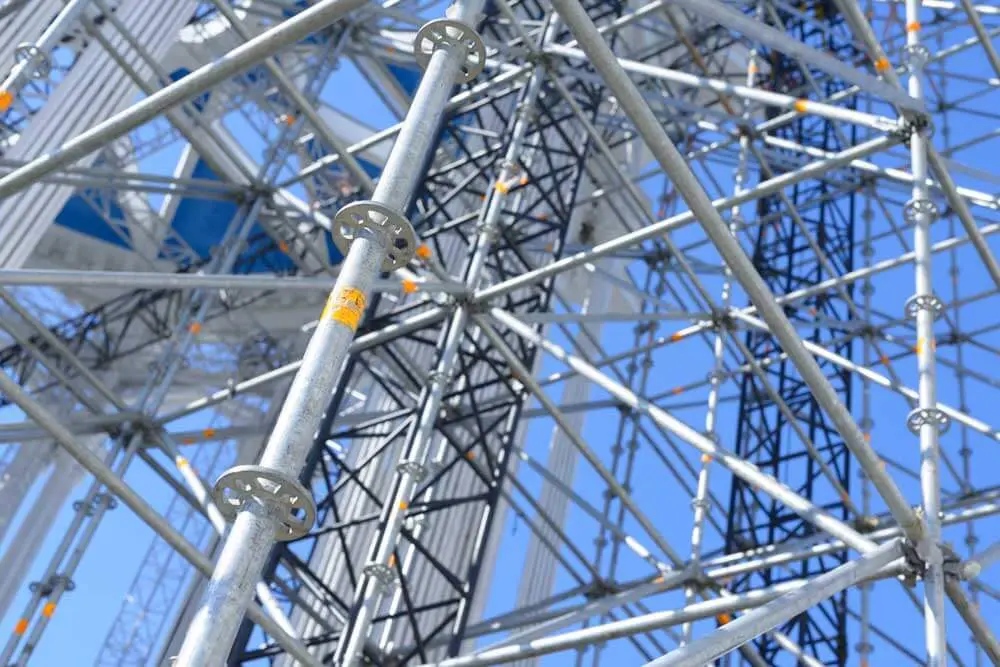
Working access comes second. The scaffold has to put the removal team at the right height to work safely, with full toe-boards, double guard rails, and deck boards tight enough that dust and debris drop cleanly into the containment below. We board out the working lifts and we’ll specify Layher system where it saves time, tube-and-fitting where it trims around pipework and plant.
Programme is third. We time erection so the enclosure is ready for the removal contractor to take over, and we’re back on site the moment the four-stage clearance is issued so you’re not paying hire on a redundant scaffold.
Working on live industrial sites
A lot of our asbestos removal scaffolding is inside live factories, warehouses and plants where production can’t stop for the removal. That means access routes, fire escape retention, and noise windows all matter. We’ll coordinate with your site manager on all of it, and we’ll provide method statements, risk assessments, and daily toolbox talks that integrate with your site’s existing safety regime.
If you’ve got an upcoming licensed removal and you want a scaffold partner who already understands CAR 2012, get in touch.